People often ask, “Do you drink the water in your RV?”
“Yes,” we reply, “and it’s delicious.”
We double-filter it. Here’s how we do it.
With regard to water sources, often we are reliant on unfamiliar public taps. So we use two products that work together to filter our drinking water. That’s why our water is “double-filtered.”
The first is the water filter. This is simply a large water filter that easily attaches to the hose between the “city water” supply and the RV. It’s a big boy and promises to last the entire camping season. We typically attach a new one at the beginning of summer. It filters all water before it ever enters our RV. (And by the way, the best deal on these filters is buying a two-pack.)
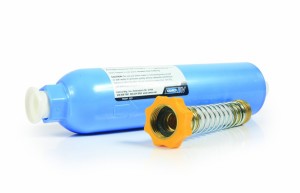
This is our first line of filtration – all water is filtered before it ever enters our holding tanks.
If you read the Camco fine print, the company promises a “100 micron fiber filter” that “greatly reduces bad taste, odors, chlorine and sediment in drinking water.” While I haven’t bothered to measure the microns, I know this filter works.
I’ll never forget the time we attached our filter to the well water supply at an old rural well in Texas. We didn’t realize that the well water was full of nasty sediment. When we turned on the well water, our Camco filter quickly clogged with dirt and mud. We ruined our filter on that day, but I was impressed that it caught so much sediment. It died for a good cause.
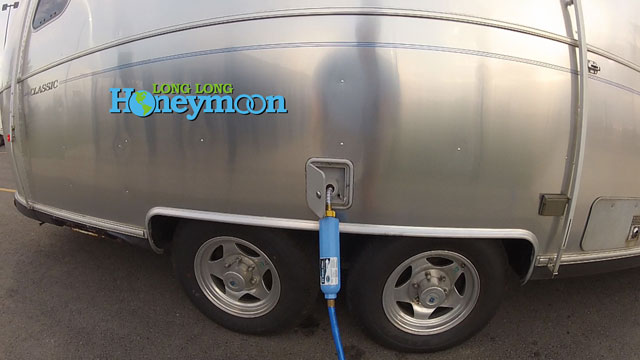
The Camco filter in action. It does a great job. (Click the pic for more info.)
Camco also promises that its product is “a high-flow carbon filter with KDF” to help prevent bacteria growth. Wait – what the heck is KDF? Is this kind of like Certs and Retsyn? KDF stands for “Kinetic Degradation Fluxion.” You didn’t know that? KDF is a metal alloy of copper and zinc that is used in water filters to make them more effective. Water filtration media is used in a flaked or granulated particulate form and usually appears to be gold or brass in color. In other words, this filter has good stuff inside that works. Okay, now you can go back to forgetting what “KDF” means. Whew.
The second product we use with our drinking water is a Brita Bella water pitcher. The Bella is a very small water pitcher that just barely fits inside our little Airstream refrigerator. Anything larger would not fit in our fridge. (If you have a fullsize refrigerator, you might as well go for a larger Brita pitcher.) The Bella pitcher has a standard Brita filter built into it. We put water from our kitchen faucet (water that was already filtered by the Camco before entering our RV holding tank) into the Brita pitcher. So the Brita pitcher filters our drinking water a second time.
As an added bonus, the name “Brita Bella” allows me to walk around the campsite, gesticulating wildly, while shouting “Brita Bella!” in an exaggerated Italian accent.
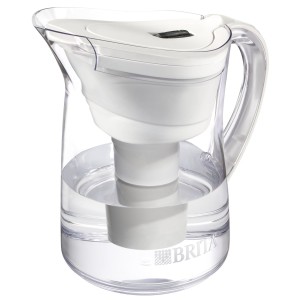
This is one of the smallest water pitchers that Brita makes. It just BARELY fits inside our tiny Airstream refrigerator . The Bella contains its own water filter, so our drinking water gets filtered a second time. Plus, I get to exclaim “Brita Bella!” in an exaggerated Italian accent.
Not to be outdone by KDF, Brita says its filters are specially engineered with “an Ion Exchange Resin” to grab hold of impurities found in tap water like lead, copper, mercury, cadmium, and zinc. Wait – what the heck is an Ion Exchange Resin? I could explain in great detail, but I’m afraid it might put you to sleep. Ion Exchange Resin is kind of like KDF and flux capacitors– good stuff that works.
With these two filtration systems working together, our drinking water tastes fantastic. It tastes fresh, clean, and free of impurities.
Of course, not everyone may want to take the step of double-filtering their RV drinking water. Some may want to simply choose one of these filters and leave it at that. Does double-filtering make a big difference?
Since we are drinking daily straight from our Airstream tanks, we like to go the double filtration route. It costs a little more, but these individual water filters actually last an entire camping season. Of course, filtering tap water is much cheaper and better for the environment than drinking bottled water. And the resulting drinking water tastes great.
评论
发表评论